
Home / Diesel vs electric
Diesel vs electric forkliftsWhat switching from diesel really saves
A typical 2.5 tonne forklift on one shift costs about €7,300 a year in diesel. An EP lithium electric doing the same work uses about €4,700 of electricity, or about €2,050 if you charge it overnight on a night rate.
- 36% lessenergy cost on a day-rate tariff
- 72% lesscharging overnight on a night rate
- No engineno oil, filters, exhaust or DPF to service
A 2.5 tonne forklift, one shift, a full year
Same work, same test cycle, real Irish prices. Both trucks are measured on the EN 16796 standard energy test, so the figures compare like with like.
| Diesel (gas oil) | EP lithium, day rate | EP lithium, charged overnight | |
|---|---|---|---|
| Use per hour | 2.7 litres | 7.43 kWh | 7.43 kWh |
| Use per year (2,000 hours) | 5,400 litres | 14,860 kWh | 14,860 kWh |
| Price | €1.357 a litre | €0.3174 a kWh | €0.1381 a kWh |
| Energy cost a year | €7,328 | €4,717 | €2,052 |
| Saving against diesel | – | €2,611 (36%) | €5,276 (72%) |
2,000 hours is 8 hours a day for 250 days. Diesel: a Linde H25 D, 2.7 litres an hour. Electric: an EP EFL253, 7.43 kWh an hour. Prices from SEAI's commercial fuel cost comparison, 1 July 2026, including VAT; electricity is the business band for 20 to 500 MWh a year, and the night rate needs a night-rate meter. Your hours, tariff and charger losses will change the result, so use the savings calculator with your own figures.
In Northern Ireland the gap is wider
Since 1 April 2022, forklifts can only run on red diesel if they work solely in farming, horticulture, fish farming or forestry. Everyone else pays full-duty diesel. At the Consumer Council's average of 190.3p a litre (22 October 2026), the same 5,400 litres costs £10,276 a year before servicing.
The parts you stop paying for
An electric forklift has no engine, so a whole list of service items disappears. What's left is tyres, brakes, hydraulics and the mast, the same as any forklift.
- Engine oil and oil filters
- Fuel filters and water separators
- Air filters
- Coolant and radiator
- Exhaust system
- DPF cleaning and AdBlue on Stage V engines
- Battery watering (lithium needs none)
- A battery room or acid spill kit
On contract hire from 12 months, servicing, repairs and GA1/LOLER inspections are included in one monthly payment.
| Diesel | EP lithium | |
|---|---|---|
| Indoors | Exhaust fumes, needs ventilation | No exhaust |
| Noise | Engine noise all shift | Quiet |
| Refuelling | A few minutes at the tank | Charge overnight, top up on breaks |
| Cold mornings | Glow plugs and warm-up | Full power from the start |
| On site | Fuel storage and deliveries | A power supply where it parks |
| Upfront price | Usually lower | Usually higher |
When diesel can still make sense
Electric suits most Irish yards and warehouses, but not every one. If any of these sound like your site, talk to us before you switch.
No power where the trucks park
Remote yards or sites with no supply nearby. We can often run a charger from an existing board, and we check this on the site survey.
Unmade, rough ground
EP indoor/outdoor trucks handle concrete, tarmac, ramps and hardcore yards on pneumatic tyres. Fields and rough building sites still need a rough-terrain machine.
Round the clock with no breaks
Lithium can be topped up at any break, and bigger batteries cover most double shifts. A truck that genuinely never stops needs a proper look at battery size first.
Very low hours
A forklift used for an hour a day saves less, so the higher purchase price takes longer to win back. Hire can make more sense than buying.
The EP electric that replaces your diesel
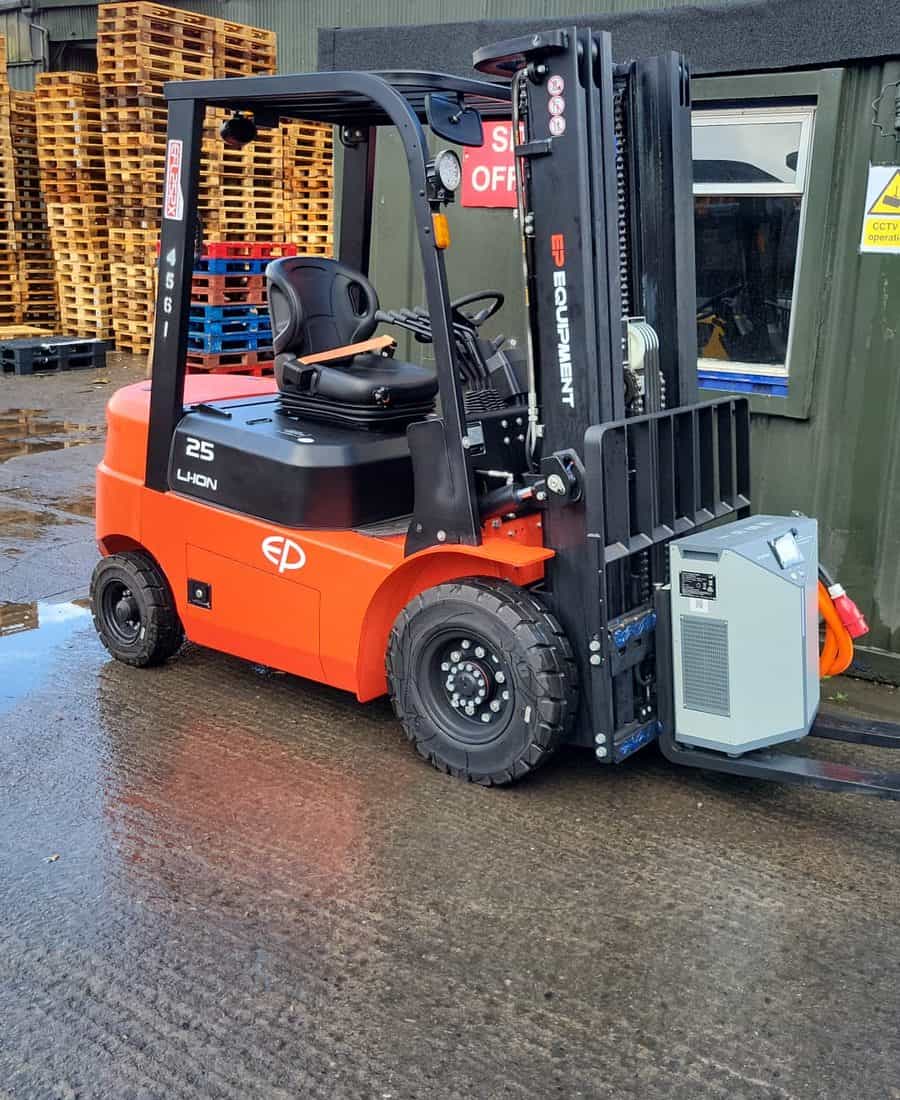
Match your diesel's capacity and you'll find an EP lithium truck built on the same kind of chassis, with the ground clearance and tyres for yard work.
| Your diesel | EP electric to look at | Why |
|---|---|---|
| 1.5 to 1.8 t | EFL183 | 80V lithium, pneumatic tyres, lifts to 6 m |
| 2 t | EFL203 · EFL203P | Yard clearance; the P is faster and climbs steeper ramps |
| 2.5 t | EFL253 · EFL25-PRO | EFL253 on an IC-style chassis; the PRO adds pneumatic tyres and IPX4 |
| 3 t | EFL303 · EFL30-PRO | Same capacity and lift, no exhaust |
| 3.5 t | EFL353 · EFL35-PRO | Heavier loads, larger batteries |
| 5 t and up | EFL504 · high-capacity range | Electric up to 25 t for the heaviest work |
Not sure which? Answer a few questions and we'll suggest a match.
What you need to charge it
Many EP lithium trucks have a charger built in and plug into a standard socket. Larger batteries use an external charger, and some need a three-phase supply. We check your power on the site survey before you order.
Lithium can be topped up at any break without harming the battery, so most single shifts run on one overnight charge. Put it on a night-rate meter and you get the lowest energy cost in the table above.
Switching from diesel: common questions
How much will I save by switching from diesel to electric?
It depends on your hours and electricity tariff. For a 2.5 t truck working 2,000 hours a year, energy costs fall by about 36% on a day-rate tariff and about 72% if you charge overnight on a night rate, before any servicing savings. Use the savings calculator with your own figures.
Do electric forklifts cost more to buy than diesel?
Usually, yes. The lower energy and servicing costs win the difference back over the truck's life, faster the more hours it works. Contract hire from 12 months spreads the cost into one monthly payment with servicing included.
Can an electric forklift work outside in the rain?
Yes. EP indoor/outdoor forklifts run on pneumatic tyres with yard ground clearance, and many are IPX4 rated against splashing water. They suit concrete, tarmac, ramps and hardcore yards, but not rough, unmade ground.
Can my forklift still run on red diesel in Northern Ireland?
Only if it works solely in agriculture, horticulture, fish farming or forestry. Since 1 April 2022, forklifts in warehouses, manufacturing, construction and haulage yards have to use full-duty diesel.
What do I need on site to charge an electric forklift?
A power supply where the truck parks. Many EP models have a built-in charger that uses a standard socket; larger batteries use an external charger, which may need three-phase power. We check this on a free site survey.
Will one charge last a full shift?
For most single shifts, yes. Lithium can also be topped up at any break without harming the battery, which covers most double shifts. We size the battery to your hours.
Tell us about your diesel fleet
Send us the trucks you run and the hours they work. We'll match each one to an EP electric and show you the running costs side by side, to buy or on contract hire.
Navan (ROI) 01 5267 411 · Portadown (NI) 028 3833 7038
Where the figures come from
- Diesel and electricity prices: SEAI Commercial Fuel Cost Comparison, 1 July 2026.
- Diesel use, 2.7 litres an hour (EN 16796): Linde H20 to H35 datasheet.
- Electric use, 7.43 kWh an hour (EN 16796): EP EFL253 specifications.
- Northern Ireland diesel price: Consumer Council fuel price checker, 22 October 2026.
- Red diesel rules: HMRC Excise Notice 75.
Send us a message
Leave your details and we'll come back to you, usually within a few hours.
Thanks, we've got your message
We'll be in touch, usually within a few hours during business hours.
Prefer to chat? Message us on WhatsApp