Last updated: November 2026
The battery decides how long an electric forklift works between charges, how much care it needs and how much it costs to run. Most forklifts today run on either a lithium-ion or a lead-acid battery. Here’s how they compare, and what to ask before you choose.
Lithium-ion batteries
- Charging: made for topping up on breaks: EP’s replacement battery adds about 7% in 10 minutes. Full charge time depends on the battery and charger.
- Shifts: EP says its lithium batteries are built for shift-break charging, so drivers top up instead of swapping batteries.
- Life: EP guarantees its replacement batteries for 2,000 full cycles with over 80% of their capacity left, against about 1,000 for lead-acid.
- Care: sealed, with no watering and no acid.
- Charging room: EP lithium batteries need no water filling, ventilation or acid handling, so you usually don’t need a ventilated battery room.
- Safety: every EP lithium battery has its own battery management system, which watches cell temperature and protects against voltage and temperature extremes.
Lead-acid batteries
- Charging: usually around 8 hours on charge, plus time to cool down.
- Shifts: a truck working more than one shift usually needs a second battery and battery changes.
- Care: regular watering, and careful handling because of the acid.
- Charging room: lead-acid gives off hydrogen while charging, so it needs a ventilated area, with an eyewash station and watering kit.
- Cost: a lower price at the start, with more upkeep over the battery’s life.
Chargers
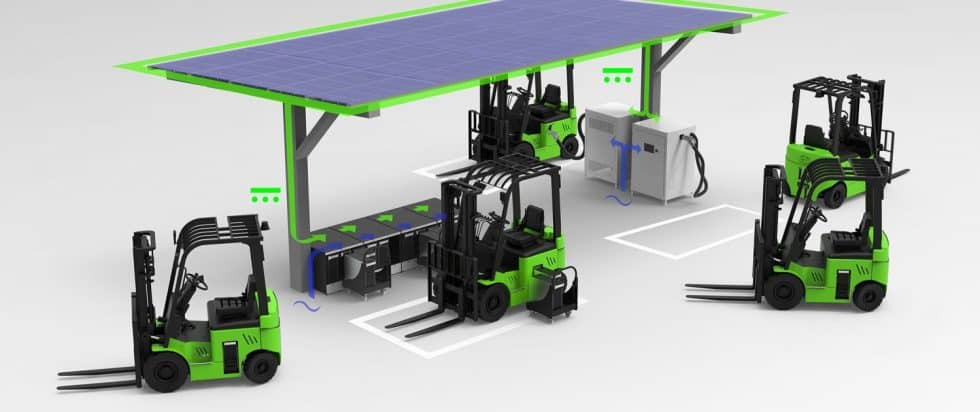
Every battery needs the charger that matches it. A lithium-ion charger is designed for fast, partial top-ups, and the battery management system talks to it to keep each charge safe. Wherever the charger goes, it needs a suitable spot and power supply, and we check that when we look at your site.
Which should you choose?
For most sites, lithium-ion is the better choice: it charges on breaks, needs no care and lasts longer. Lead-acid can still make sense for a lightly used truck on a single shift. Most EP forklifts we supply run on lithium-ion, and a few compact models can also take a lead-acid battery.
See our lithium-ion forklifts page and use the savings calculator to compare running costs, or read the advantages of lithium-ion forklifts and can electric forklifts last a full shift?
Talk to us
Tell us how many hours your trucks work and we’ll recommend the right battery and charger the same working day. Call 01 5267 411 (ROI) or 028 3833 7038 (NI), or send us a message.